The missing layer between observability and benchmarks.
Over the last year, Agentic AI has exploded.
OpenAI has agents.
Anthropic has agents.
Google DeepMind has agents.
Every startup suddenly has a multi-agent architecture diagram.
And if you look closely, something interesting has happened.
The industry solved observability.
The industry largely solved benchmarks.
Yet somehow, we still cannot answer a deceptively simple question:
Was this agent actually good?
Not “did it finish.”
Not “did it return the correct answer.”
Not “did it beat another model on a leaderboard.”
Was the behavior itself good?
That sounds like a trivial question.
It isn’t.
The Three Layers of Agent Evaluation
Most people think evaluation is a single thing.
In reality, the ecosystem has evolved into three distinct layers.
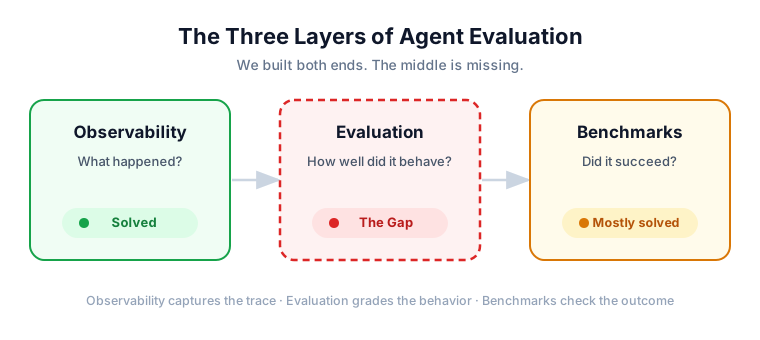
The first two layers are advancing rapidly.
The third layer barely exists.
Layer A: Observability Is Mostly Solved
A few years ago, debugging AI agents was painful.
You had no idea what happened between the prompt and the final answer.
Today that’s no longer true.
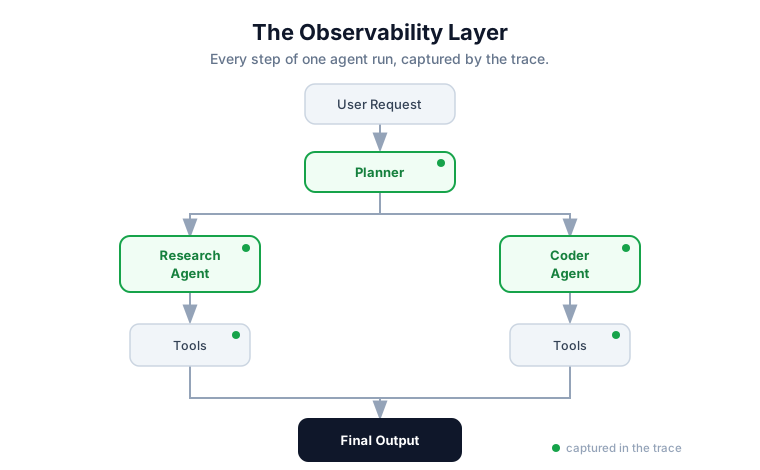
The ecosystem has largely standardized around tracing.
Platforms such as LangSmith, Braintrust, Arize Phoenix, Langfuse, MLflow, AgentOps, and OpenTelemetry can capture nearly every step of an agent execution.
A modern trace can tell you:
- Which tools were called
- Which prompts were used
- Which agent delegated work
- How many tokens were consumed
- How much latency was introduced
- Which branch of execution was taken
The industry now has excellent visibility into agent behavior.
The question is no longer:
What happened?
The traces already tell us.
Layer B: Benchmarks Are Mostly Solved
The second layer is benchmark evaluation.
The ecosystem has produced a remarkable collection of benchmarks:
| Benchmark | Measures |
|---|---|
| GAIA | Tool use + reasoning |
| SWE-bench | Software engineering |
| OSWorld | Computer use |
| WebArena | Web navigation |
| MLE-bench | ML engineering |
| PaperBench | Research replication |
| τ-bench | Agent-user interactions |
These benchmarks answer a useful question:
Can the agent complete a predefined task?
This is important.
But there is a hidden assumption.
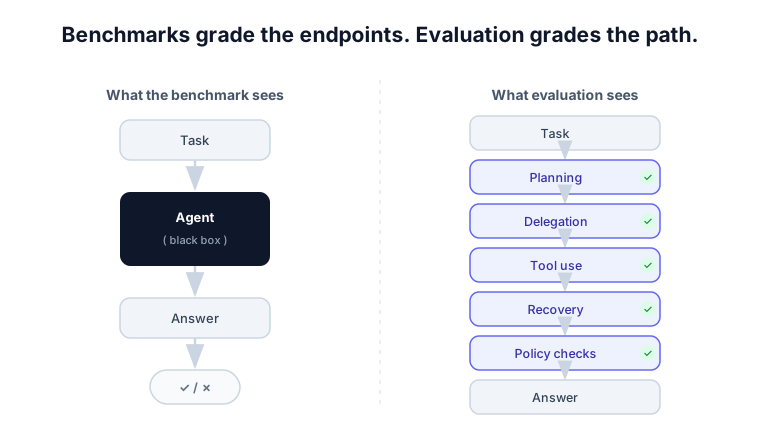
The benchmark only cares about the final score.
It rarely cares about how the score was achieved.
The Hidden Problem
Imagine two agents.
Both successfully book a flight.
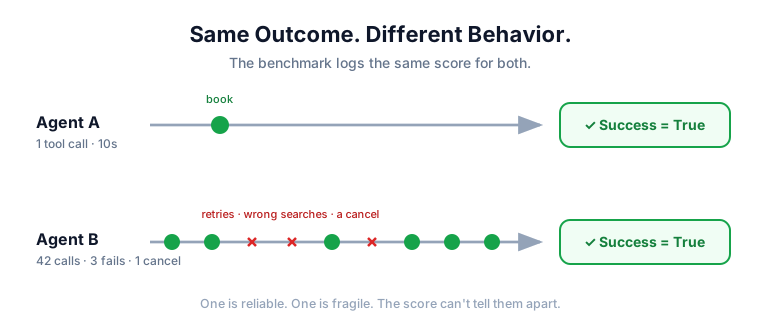
Both agents receive the same score.
Yet anyone who has deployed production systems knows these agents are fundamentally different.
One is reliable.
One is fragile.
The benchmark cannot see the difference.
The Missing Layer
This is where evaluation begins.
Not benchmarking.
Evaluation.
The missing question is:
How well did the agent behave while solving the task?
Consider these failure modes:
| Failure Type | Example |
|---|---|
| Wrong plan | Correct tools, bad reasoning |
| Wrong tool | SQL needed, calculator used |
| Wrong parameters | API called incorrectly |
| Handoff failure | Context lost between agents |
| Infinite delegation | Agents bouncing forever |
| Memory corruption | Shared state overwritten |
| Policy violation | Unauthorized action |
| Cost explosion | Thousands of unnecessary tokens |
| Latency explosion | Dozens of unnecessary calls |
A benchmark score cannot distinguish among these.
But production systems care deeply about them.
Anthropic’s Important Insight
One of the most important evaluation principles published recently is surprisingly simple:
The transcript is not the outcome.
An agent can say:
“Your flight has been booked.”
That does not mean the flight was booked.
The real evaluation target is the environment itself.
Did a reservation actually appear in the database?
Did the file actually get created?
Did the code actually compile?
Did the money actually move?
The distinction sounds obvious.
Yet much of the industry still evaluates text instead of reality.
The Gap Nobody Owns
This is where things become interesting.
Observability platforms do not solve this problem.
Benchmark leaderboards do not solve this problem.
Most agent frameworks do not solve this problem.
Everyone captures traces.
Everyone reports benchmark scores.
Almost nobody grades the trace itself.
Especially for:
- Multi-agent coordination
- Context preservation
- Delegation quality
- Safety compliance
- Recovery behavior
- Long-horizon reasoning
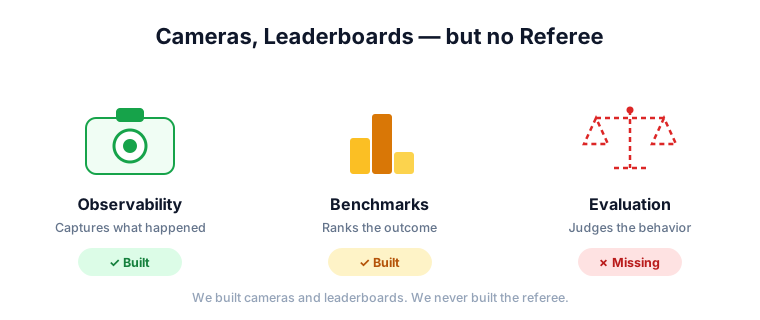
The industry has built cameras.
The industry has built leaderboards.
The industry has not built referees.
The Opportunity
The next major category in Agentic AI will not be another benchmark.
It will not be another observability platform.
It will be an evaluation layer.
A system that can consume traces from any framework, evaluate how the agent behaved, and produce standardized scores for:
- Trajectory quality
- Coordination quality
- Safety compliance
- Cost efficiency
- Reliability
- Recovery ability
In other words:
Observability
      ↓
Evaluation
      ↓
Benchmarking
Today the middle layer is missing.
That is where the biggest opportunity lies.
Final Thought
The AI industry spent years asking:
Can models answer questions?
Then it asked:
Can agents complete tasks?
The next question is harder.
And ultimately more important.
Can we objectively measure whether an agent behaved well while completing those tasks?
Until we answer that question, every leaderboard is incomplete.
Every benchmark is partial.
And every production deployment is operating with a blind spot.
The future of Agentic AI is not just building agents.
It’s learning how to evaluate them.
